Pera Industry Shanghai Co., Ltd

Pera Industry: Your Professional Tap Manufacturer!

Pera Industry Shanghai Co., Ltd is one of the leading suppliers of beer set products and related products in China. We have established a new factory in Yuhuan City to produce beer taps, beer towers, beer kegs, keg couplers, PET kegs, brewing accessories, etc. Later, we reached cooperation with partners in Saudi Arabia, moved our headquarters to Shanghai in 2018, and established Pera Industry Shanghai Co., Ltd.


Our Advantages


Innovative Enterprise

35 years of production experience is our advantage and the source of our innovation strength. Some products have obtained utility model patent certificates and design patent certificates.

Rapid Manufacturing

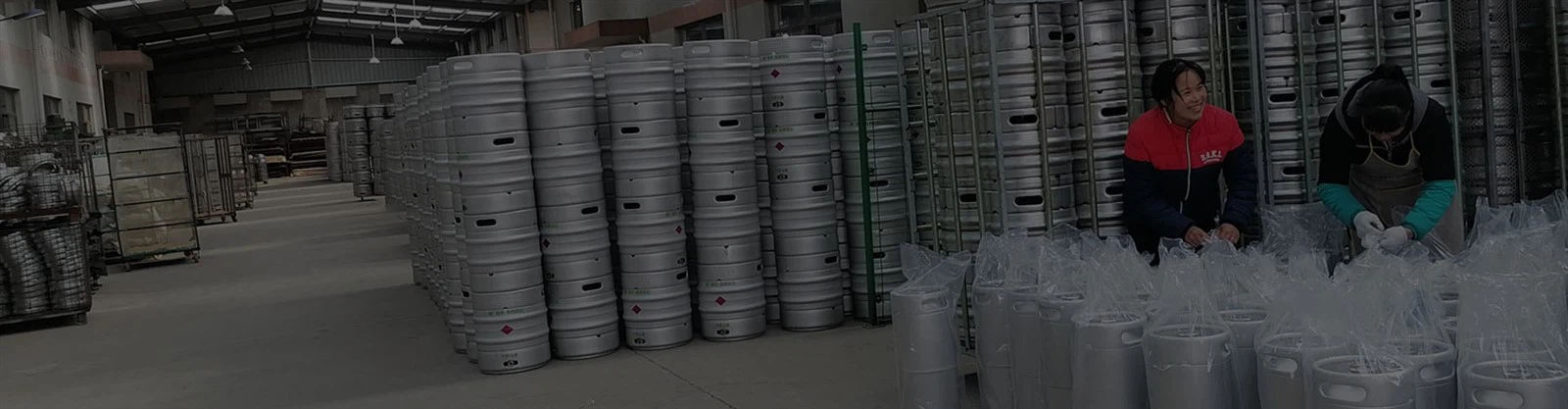
A factory covering an area of 2,000 square meters, over 100 experienced employees, 24 sets of extrusion production lines and a number of CNC lathes means we can achieve high-volume production.

Consistent Product Quality

Our production process is scientific and stable, and the product quality is very reliable.

Expansive Market Reach

Our sales network currently covers more than 30 provinces and cities in China, and some products are exported to more than 150 countries in Europe, North America, South America, the Middle East, Africa, Southeast Asia, and other places.


productcate-886-800


TJ077A016
productcate-886-800
TJ077A0226
productcate-800-800
TJ077C087
 

productcate-886-800

TJ077C087N
productcate-886-800
TJ077C087N-1
productcate-886-800


TJ077A058
productcate-886-800
TJ077A056
productcate-886-800
TJ020A017


What is a Tap?

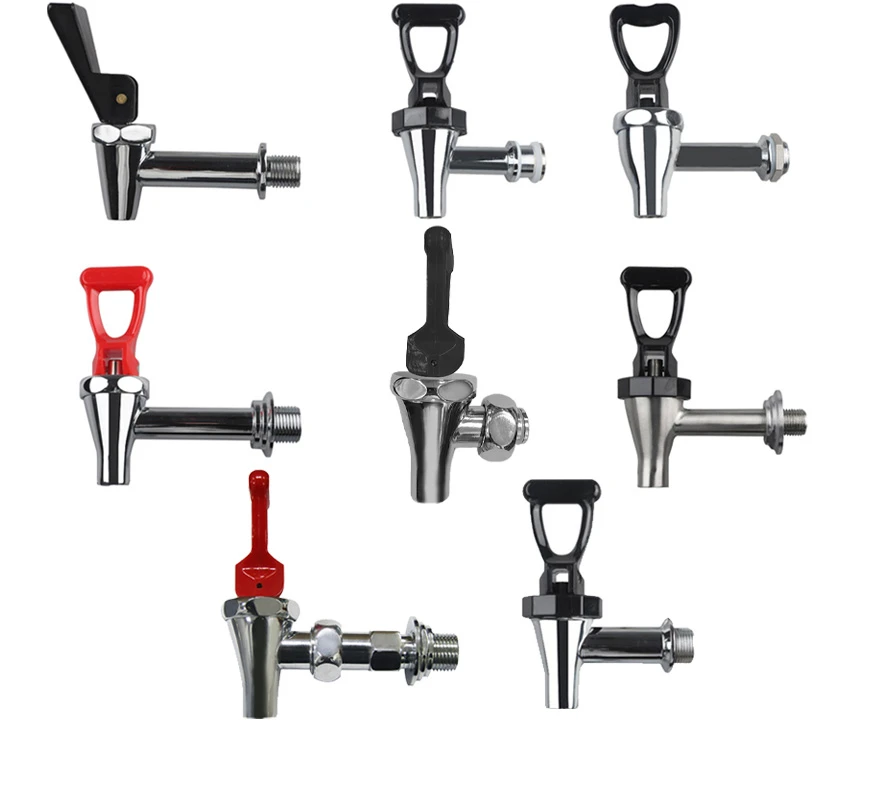
A beer tap is a valve, specifically a tap, for controlling the release of beer. While other kinds of tap may be called faucet, valve or spigot, the use of tap for beer is almost universal. The word was originally coined for the wooden valve in traditional barrels.

SS Growlers


Types of Beer Faucets


Standard Faucets

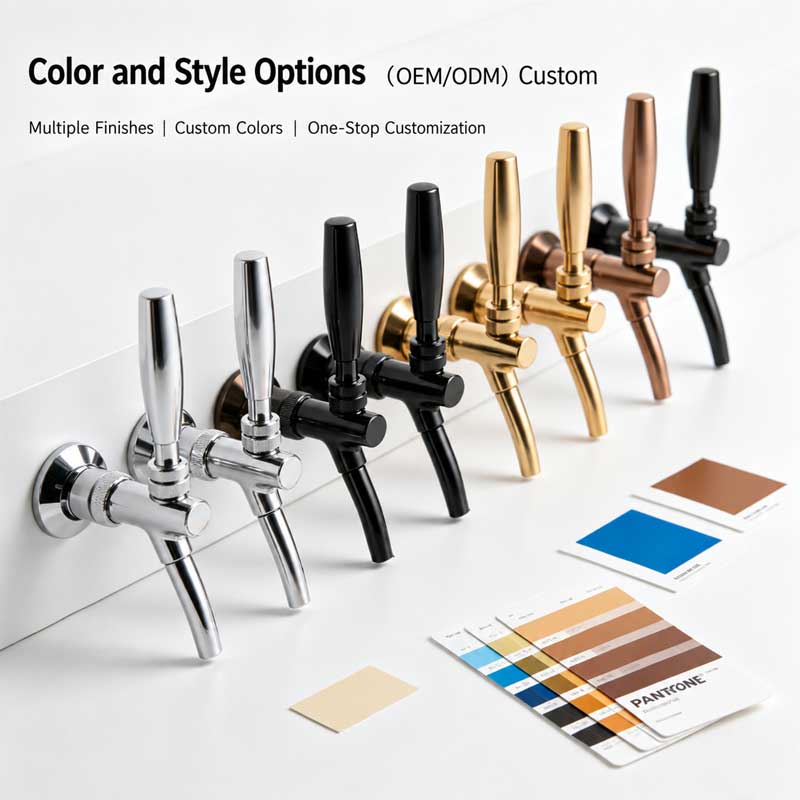
Standard faucets are what you probably already associate with a “beer faucet.” Without a doubt, this is the most common type of beer faucet out there, and is likely the one that is found on your personal kegerator, as well as the majority of commercial draft systems This faucet is designed to dispense a wide variety of beer styles. Typically rear-sealing, this beer faucet are widely available in a variety of shapes, sizes and finishes. The standard beer faucet is designed for easy installation and can be swapped out with ease. This includes the draft tower of your kegerator, as well as a shank for through-the-wall or door-dispensing units, such as a converted kegerator.

 
European Faucets

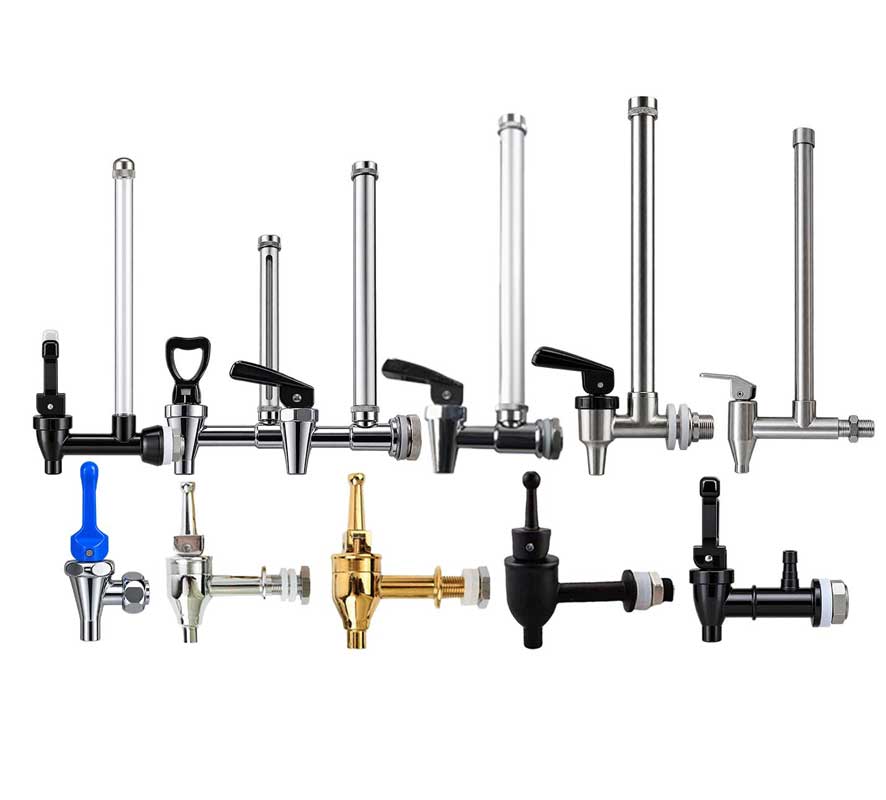
European faucets work in the same manner as a standard beer faucet, yet stylistically they look slightly different. The most noticeable distinction between the two types of beer faucets is the longer, skinnier spout found on the European version. This helps decrease the overall amount of foamhead in your pour. However, it is important to note that sometimes, European beer faucets will have different threads and/or a shorter shank than your standard US-style beer faucet. This will likely affect whether you have the ability to connect or swap out your existing component on your kegerator with this type of faucet. It is not uncommon for you to need to buy a new draft tower or shank to make this faucet work.

 
Stout (Nitrogen) Faucets

Stout beer faucets are designed to accommodate a nitrogen-based draft system. Most popularly, these are used to dispense nitro beers and stouts, such as Guinness (hence the name of the faucet). This type of beer faucet has a very small, precise opening intentionally designed to allow for a very slow pour. If you’ve ever watched a bartender pour a Guinness beer, they pour it very slowly and in two stages. In fact, for Guinness specifically, if they pour it correctly, it should take at least two minutes. This slower pour is to allow for a perfectly foaming head that allows the aroma to blossom. This helps create a smoother, creamier beer. If you were to dispense a stout or nitro beer using a standard faucet, it would come out way too quickly and likely be full of foam.


Benefits of Taps
Cornelius Keg
 

Less Waste

Our draft systems are designed to minimize waste in the form of foam and stale beer. A recent survey of business owners showed that, on average, roughly 20% of each keg was being wasted! While beer waste stems from several factors, equipment problems, poor temperature regulation, inadequate pressure and unsanitary tap lines are among the biggest offenders. Many business owners simply don’t realize how much sellable product is going to waste, but your bottom line can be greatly affected by this waste.

Cornelius Keg
 

Happier Customers

As the craft beer and craft beverage industry continues to explode in popularity, customers have more and more choices, both in terms of brewers and drinking establishments. Savvy customers now know when a beer is fresh and well-poured – and when it’s not. Business owners nowadays must work to distinguish themselves from the competition – and one of the best ways to do that is to serve the freshest, coldest, best-poured beer in the area.

Tin Can Keg
 

More Revenue

The bar and restaurant industry can be a challenging one, but it can also be quite lucrative for those who find success. Maximizing revenue is one of the best ways to improve your bottom line, and our services can help with that! By serving fresher, cleaner, tastier beverages, your customers will leave happy – probably after ordering at least one more drink. At the same time, by wasting less product with our taps you will be able to sell more units out of each keg. Win, win!

Plastic Beer Tower
 

Peace of Mind

As a business owner, you likely have more than enough to worry about – let us handle this small but essential component of your business. Our expertise and professional grade equipment ensure a well functioning, optimized beverage dispensing system for years to come.


Components of a Beer Tap

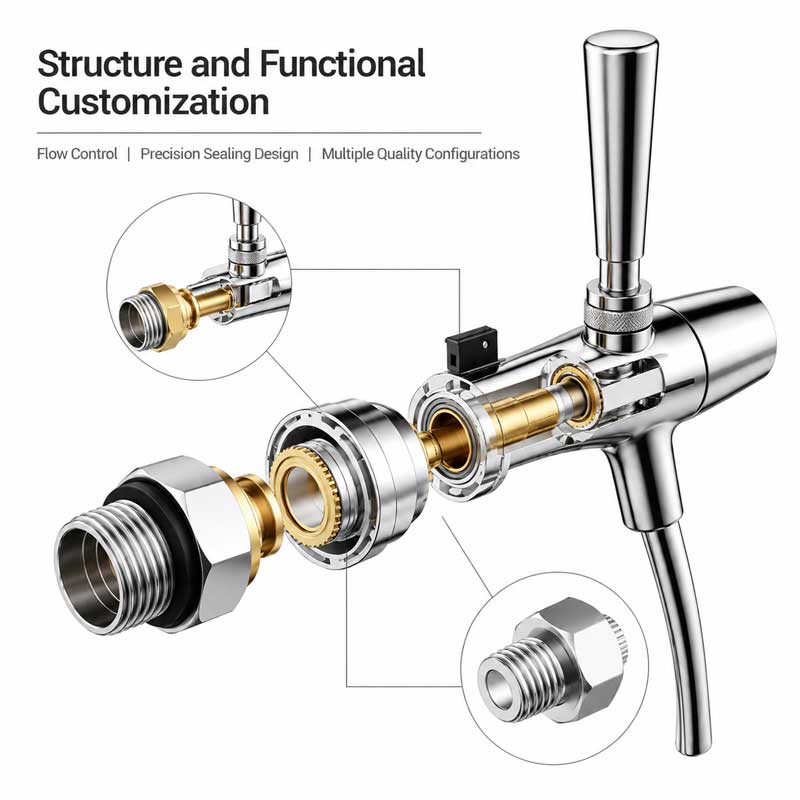
A standard beer tap consists of several parts, including:

Faucet Body

The largest component of the beer tap, it directs the flow of beer through the spout to your waiting glass. Faucets come in different finishes, but we recommend stainless steel to ensure metallic flavors don't taint your beer.

01

Coupling Washer

This small but essential part seats the faucet to the beer shank for a leak-free connection.

02

Lever

The lever is the part of the faucet that you pull to dispense the beer. It is typically made of brass or stainless steel.

03

Bonnet

The bonnet is the top part of the faucet that covers the internal workings of the tap. It is usually made of brass or chrome-plated brass.

04

Shank

The shank is the part of the beer tap that connects the faucet to the beer line. It is typically made of brass or stainless steel and comes in different lengths to accommodate different thicknesses of walls or cooler doors.

05


Materials of Taps
Table Liquor Dispenser
Wall Mounted Liquor Dispenser
Rotating Liquor Dispenser
Shot Liquor Dispenser

Chrome Draft Beer Faucets
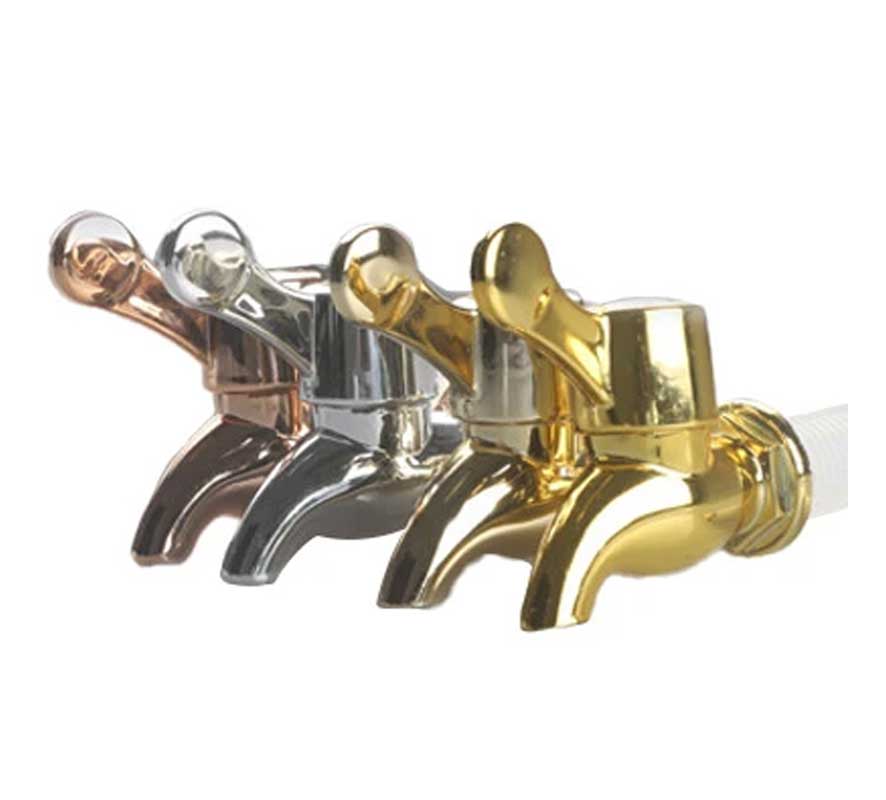
Chrome-plated brass faucets are the most common style of faucet you will find. The shiny chrome finish is visually appealing, and stands out behind any bar. They are more cost-effective and have the same function as stainless steel, but they don’t hold up well to the wear and tear of long-term continuous use. After years of use and exposure to low-level acidity from both the beer itself and various cleaning agents, a traditional chrome-plated faucet may begin to corrode and impart unwelcome flavors to your brew. If you are building a kegerator for your home or a draft system that won’t receive a high-level of use, then chrome-plated faucets are still a viable option for you. Just be sure to monitor the level of wear over time.


Stainless Steel Draft Beer Faucets
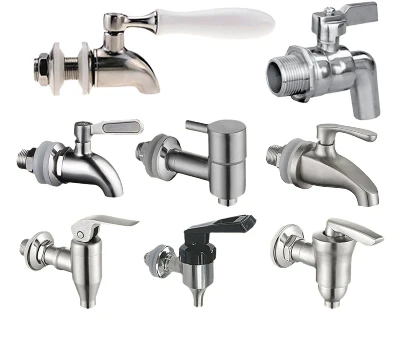
Stainless steel faucets are an upgrade over the standard option. The added value of having a sturdy stainless steel faucet that will last for many years behind your bar balances the trade-off of the premium cost. Since stainless steel is less susceptible to corrosion it makes it a much more sanitary option because it is much more resistant to the formation of bacteria. For that reason, stainless steel is a must if you want to dispense wine on tap, coffee on tap, kombucha on tap or cocktails on tap because the acidity in these beverages will almost immediately corrode the finish of a plated-brass faucet and render whatever winds up in your glass undrinkable.


Polished Brass Faucets
If you crave the look of polished brass for your faucets, then you do have options. A polished brass draft faucet offers the same affordability and functionality as its chrome-plated counterpart. You can also get a stainless steel faucet with a tarnish free brass finish that provides the look of brass on the outside, but with the durability of stainless steel on the inside.


Things to Consider Before Choosing a Tap
 

Often called beer taps, beer faucets are the last component your beer touches before it gets into your glass. Every faucet is meant to ensure that your brew flows smoothly and that you get that perfect pour we all strive for. In addition to faucets, tap handles are connected to them. Particularly in commercial environments, they allow users to know what type of beer will be served from a specific faucet. When it comes to choosing the right beer tap, there are a few things you need to consider. In this article, we will discuss a few tips for choosing the right beer tap.

Consider Your Needs

When choosing a beer tap, it is important to consider your needs. You may want a tap that can fit in your kitchen or bar area or one that has more features. Some features you may want include a digital reader for pouring beer, temperature control, and a keg connection.

productcate-180-120
productcate-180-120

Consider the Size of the Tap

Another important factor to consider is the size of the tap. If you have a small restaurant or bar, you may want a small tap. On the other hand, if you have a larger restaurant or bar, you may want a larger tap.

Consider the Style of Beer You Want to Serve

Finally, decide what type of beer you would like to drink. If you are a fan of craft beers, then you may want to look for a craft beer tap. On the other hand, if you are more interested in popular beers, then you may want to look for a popular beer tap.

productcate-180-120
productcate-180-120

Make Use of Complementary Shades

It is often found that people are more likely to select brands with colorful handle designs when they are faced with unfamiliar brands. Use complementary colors between your beer style and brand to make it stand out. It will be much easier to read the lettering on a white glazed tap handle than on a dark blue glazed tap handle.

Choose a Custom, Unique Shape

Make sure your tap handle stands out from the rest. You can use a unique tap handle to make your brew stand out by integrating it into your brand’s story. Make sure to design the handle in a way that the tap handles are not wider than 3 inches.

productcate-180-120
productcate-180-120

Think of a Reliable Brand

It is important to maintain consistency within your brand if you have multiple beer styles on tap, as the customers may not be able to connect your beer to your brewery, which may hurt your brand recognition in the long run.


Maintenance Tips for Taps
Beer Kegerator

Clean the Tap Line

Turn off the carbon dioxide and remove the coupler where it is connected to the keg. Unscrew the beer hose. You can rent or purchase a recirculating cleaning pump. Use it to circulate the cleaning solution through the lines and it will get rid of mold, yeast, bacteria, and beer stones. After pumping let the solution sit in the lines for about twenty minutes. Run water through the lines a couple of times and the beer taps will be cleaned.

Beer Kegerator

Clean tap and Coupler

Remove the tap using a tap wrench. After removing the tap from the beer tower get rid of the coupler and disconnect the beer lines from the keg. Get a cleaning solution like ultrasonics, sanitizing tablets or hypochlorous acid, and soak the coupler and tap in it. Soak them overnight and use a kitchen brush to get rid of any debris. Rinse tap and coupler with clean water. Reconnect them and it will be ready to use.


Our Certificate


The quality of Pera products is at the leading level both at home and abroad, which is stable and reliable.

productcate-1-1
productcate-1-1
productcate-1-1
productcate-1-1
productcate-1-1
productcate-1-1


Ultimate FAQ Guide to Liquor Dispensers


Q: Why is beer better on tap?

A: When you consider the product turnover at bars, pubs and restaurants, beer on tap sells a lot quicker than the bottles sitting in the fridge. Beer freshness has an immense impact on the brew's flavour, which is why the beer poured from a keg is likely to be fresher (and tastier) than what you'd sip from the bottle.

Q: How long can beer stay on tap?

A: Keg beer will remain fresh if dispensing with CO2 while maintaining the proper temperature and pressure: For non-pasteurized draft beer, about 45-60 days. For pasteurized draft beer, about 90-120 days. NOTE: When dispensing keg beer with a party pump (air), any draft beer will remain fresh for no more than 8-12 hours.

Q: What types of beer taps are there?

A: Pressure-Dispense Bar Tap
Beer supplied in standard kegs is pumped along beer lines with the help of pressurized gases (usually carbon dioxide, sometimes nitrogen). The beer tap which controls the pressure is the decorative tap handle behind the bar. This is the most common type that you see in restaurants, pubs, and bars.
Keg Party Pumps
The type of beer tapping system most commonly seen at house parties. The unit includes a hand pump to provide air pressure in the keg, which then helps dispense the beer. Because this method introduces outside air with bacteria and other elements that will cause reactions with the beer, it is best to consume this beer within a few hours of first tapping. Learn to tap a keg at home in 5 easy steps.
Gravity Cask Tap
Cask Ale is unfiltered and unpasteurized, meaning that the yeast is still living in the container. Serving these without the aid of pressurized gases helps keep the yeast present and the slow fermentation can continue to keep the beer fresh. This is the ‘hand pump’ that almost disappeared with the advent of pressurized containers, but you may still see it at some traditional or niche beer bars. The way to tap a cask (or ‘Firkin’) is by tapping a simple on-off valve into the bottom of the container with a hammer, and letting gravity do the work. The beer simply flows out of the cask and into the glass.

Q: What are the essential parts of a beer tap?

A: Tap Handle
The tap handle is the part of the beer tap that you pull forward to initiate beer dispensing. It's usually a tapered black handle that connects to and controls the lever. Tap handles come in a variety of styles, including branded, novelty, or custom handles.
Faucet
The faucet is the part of the beer tap that actually dispenses the beer. It's the metal spout that attaches to the shank and connects to the tap handle. The faucet is opened and closed by the lever on the tap handle.
Shank
The shank is the metal tube that connects the faucet to the beer line. It's usually made of brass or stainless steel and comes in a variety of lengths to accommodate different wall thicknesses. The shank is mounted through a hole in the wall or refrigerator and is secured with a mounting flange and nut on the inside.
Draft Tower
The draft tower is the vertical column that houses the shank and faucet. It's usually made of stainless steel or chrome-plated brass and comes in a variety of heights and styles. Draft towers can be mounted on top of a bar or countertop or installed through a hole in a refrigerator door.

Q: What is the difference between a beer tap handle and a beer faucet?

A: A beer tap handle is the part that you pull forward to initiate beer dispensing. It can be replaced with a branded, novelty, or custom handle. A beer faucet is the part that controls the flow of beer. It is the part that you see when you look at a beer tap system from the front. The beer faucet is usually made of brass or stainless steel.

Q: What are the common materials used for beer tap parts?

A: The common materials used for beer tap parts are brass, stainless steel, and plastic. Brass is a good choice for beer tap parts because it is durable and corrosion-resistant. Stainless steel is also a good choice for beer tap parts because it is durable and easy to clean. Plastic is a good choice for beer tap parts because it is lightweight and inexpensive.

Q: What size are the threads on a standard beer tap?

A: The threads on a standard beer tap are 3/8"-16 UNC. This means that the thread diameter is 3/8" and the thread pitch is 16 threads per inch. It is important to use the correct size thread when installing a new beer tap handle or beer faucet. Using the wrong size thread can cause leaks or damage to the beer tap system.

Q: How a bar tap works?

A: When you open the tap or faucet, CO2 pushes beer out of the keg and into your glass. The beer will then be filled with gas, which will fill the space where the beer was previously housed. CO2 fills in the head space and maintains pressure inside the keg at the PSI set on your CO2 regulator by filling in the head space. A bar tap, also known as a valve, is a valve that allows beer to be released in controlled amounts. There are several types of taps, such as faucet, valve, and spigot, but the majority of people still use tap for beer. Originally, the term referred to the wooden valve found in barrels of wood.

Q: What’s the difference between draft and tap beer?

A: Tap beer can range from a cold one found in the refrigerator to a cold one found on the bar. The term “draft beer” refers to beer that has been tapped from the tap and served directly from the brewery. The term “bottled or canned beer” refers to beer that has been shipped from a brewery and stored in a cold place prior to consumption. Fresh beer from the tap typically tastes better than bottled or canned beer; freshness also influences taste. Aside from oxidization, its ingredients are frequently volatile, which can have an impact on the flavor. The two most common terms used when referring to beer are draft and tap. A draft beer is one that has been made from brewery-made beer and has been served to you. When it comes to tap beer, it means beer that has been pulled from the tap and served to you, but it also means beer that has been stored in kegs and drawn from taps. When it comes to draft beers, a beer that has been tapped from a tap and is being served straight from the brewery is referred to. When it comes to tap beer, it means beer that has been pulled from the tap and served to you, but it can also mean beer that has been stored in kegs and tapped.

Q: What is the function of a beer tap?

A: Its function is to preserve the beverage for a long time at a suitable temperature, and it can even be kept cold for 30 days. In the same way, the beer tap allows serving it directly in the glass, which optimizes its organoleptic characteristics and achieves a greater enjoyment.

Q: What is a drum faucet?

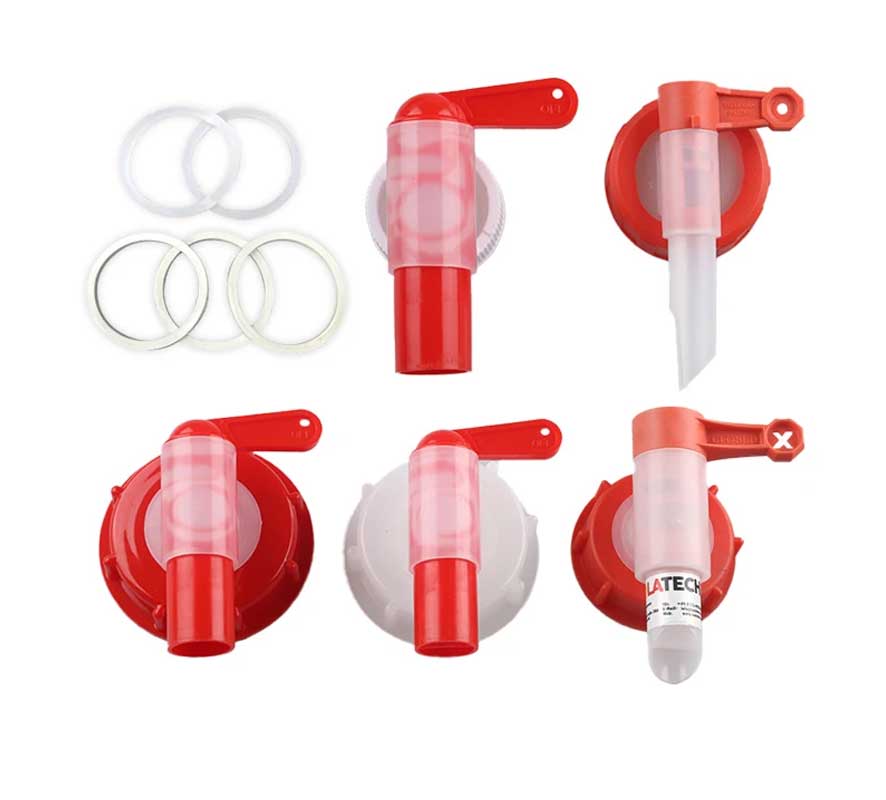
A: Drum faucets allow controlled and fast distribution of contents from drums. Also known as drum taps, they secure to bungholes and bungs with faucet knockouts. Their handles have control valves that open and close to release and stop liquids.

Q: How to pour beer from a tap?

A: 1. Choose a clean glass. You’ll want to preserve the taste of your beer—especially with craft beer. Even small amounts of residual dish soap, oil, or dust can change the flavor palate of your beer. Even seemingly clean glassware at home can have an invisible residue left by most common dish soaps that deplete some of the desired foam produced by beer. A good solution is to rinse a clean beer glass with cold water right before you pour the beer. Use a room-temperature glass since most beers achieve their fullest flavor and aroma between 50 and 55 degrees Fahrenheit.
2. Select your beer. Most tap systems have more than one type of beer on tap at a time. These might include pale pilsner lagers, amber ales, etc. All of these benefit from the following pour style to open up their unique flavors.
3. Grab from the base of the tap handle. Pulling from the base of the tap handle is proper practice, since pulling from the very top can more easily put excess pressure on the faucet and cause it to break more quickly over time.
4. Avoid contact with the faucet spout. To follow the best hygiene practices, keep the glass and the beer from touching the faucet spout.
5. Hold the pint glass at a 45-degree angle. A perfect beer pour will result in a foam layer, or “head,” at the very top of the beverage after releasing some of the CO2 and opening up the aromas and flavors beneath the foam. To begin this process of agitating the carbonation in the liquid, aim for the center of the glass. It’s okay to pour hard or leave a healthy distance between the glass and the source of the pour since you’ll want some force to release an adequate amount of foam. There will still be carbon dioxide in the beer, but this process will help minimize bloat when drinking—a step that’s especially useful if you enjoy drinking beer with food.
6. Begin turning the glass upright. Once the liquid reaches the halfway point of the beer glass, the foamy liquid will separate into a good head of foam above the liquid and you can begin to gradually tilt the glass back upright. You should have a half-inch to one-and-a-half-inch foam head at the brim when the glass is full.

Q: What do you need for a beer tap?

A: A beer tap system consists of several parts, including a beer tap handle, a beer faucet, a shank, a coupler, and a beer line. The beer tap handle is the part that you pull forward to initiate beer dispensing. The beer faucet is the part that controls the flow of beer.

Q: Do beer taps need to be cleaned?

A: All faucets should be completely disassembled and cleaned every two weeks. Make sure to replace any damaged seals or gaskets. Acid cleaning should be performed quarterly to remove inorganic compounds such as “beer stone,” which are mineral deposits.

Q: How do beer tap systems work?

A: Any draft system requires pressurized gas to propel beer from the keg to the faucet. When this pressurized gas is pushed into the keg through the coupler, it forces the beer out into the beer line where it eventually travels up to the tap so you can pour a pint on demand.

Q: What is the use of the lever on the beer tap?

A: The metal piece that controls the opening and closing of the internal valve that controls the flow of beer through the faucet body. When you pull the lever forward by way of the tap handle, it pushes the shaft backwards, which opens the valve. Levers are threaded to attach to the faucet knob/tap handle.

Q: What is the use of faucet body?

A: The largest single component of your beer faucet, it directs the flow of beer through the spout to your waiting glass. Faucets come in different finishes. We recommend stainless steel to ensure off, metallic flavors don’t taint your beer.

Q: Can I install a beer tap at home?

A: The first step in installing the wall-mounted beer tap is to choose a location for it. You'll want to pick a spot that's close to an existing water line, as this will make it easier to hook up the tap. You'll also want to make sure that there's enough space behind the wall to accommodate the tap's mounting hardware.

Q: What thread is a beer tap?

A: The 3/8"-16 size and the smaller 5/16"-18 size. The larger size (3/8-16) are used for displaying tap handles, because that is the thread of a standard American beer faucet. Both sizes are used to make tap handles and you'll find ferrules that attach both to the 3/8" and others that attach to the smaller 5/16" size.

Q: What are self-closing faucets?

A: A standard self-closing faucet does exactly what its name promises: it closes itself! The rest of the construction is the same as a standard faucet, but instead of having to manually push it closed, it will return to the closed position when you take your hand off the lever. This is a great option to help conserve beer and prevent accidental spills.

We're well-known as one of the leading tap manufacturers and suppliers in China. Please rest assured to wholesale high quality tap at competitive price from our factory. For custom service, contact us now.

tap water for brewing beer, keg tap, refrigerated beer tap

(0/10)

clearall